

From housing and job insecurity to collective action: youth confronting new social inequalities
From Anastasia Diamantakou
Contemporary social reality appears increasingly bleak, both at national and supranational levels, as it reflects a structural contradiction between the legal recognition of fundamental social rights and young people’s actual ability to exercise them. The right to decent living conditions and housing—an essential aspect of the social state governed by the rule of law—is being tested by the housing crisis, labor market deregulation, and the consolidation of precarious forms of employment.
As a result, a de facto regime of unequal treatment for young people emerges, highlighting the need for enhanced protection and targeted interventions at the European Union level.

The housing crisis versus youth autonomy
Housing has become a major social and political issue, occupying a central place in public debate. “Few rights reflect so clearly the quality of our social organization as the right to housing.” Yet, for thousands of young people in Greece and across Europe, housing has long ceased to be a given foundation of adult life.
Rising property prices, increasing rents, limited availability of affordable housing, and low wage mobility are leading to a condition of structural deprivation. For young adults, access to independent housing is no longer a “natural” life stage but a difficult and often unattainable goal.
Particularly concerning is the link between the housing crisis and growing intergenerational inequalities, with Greece recording some of the highest rates of young people remaining in the parental home up to the ages of 29–34 (Eurostat, 2024).
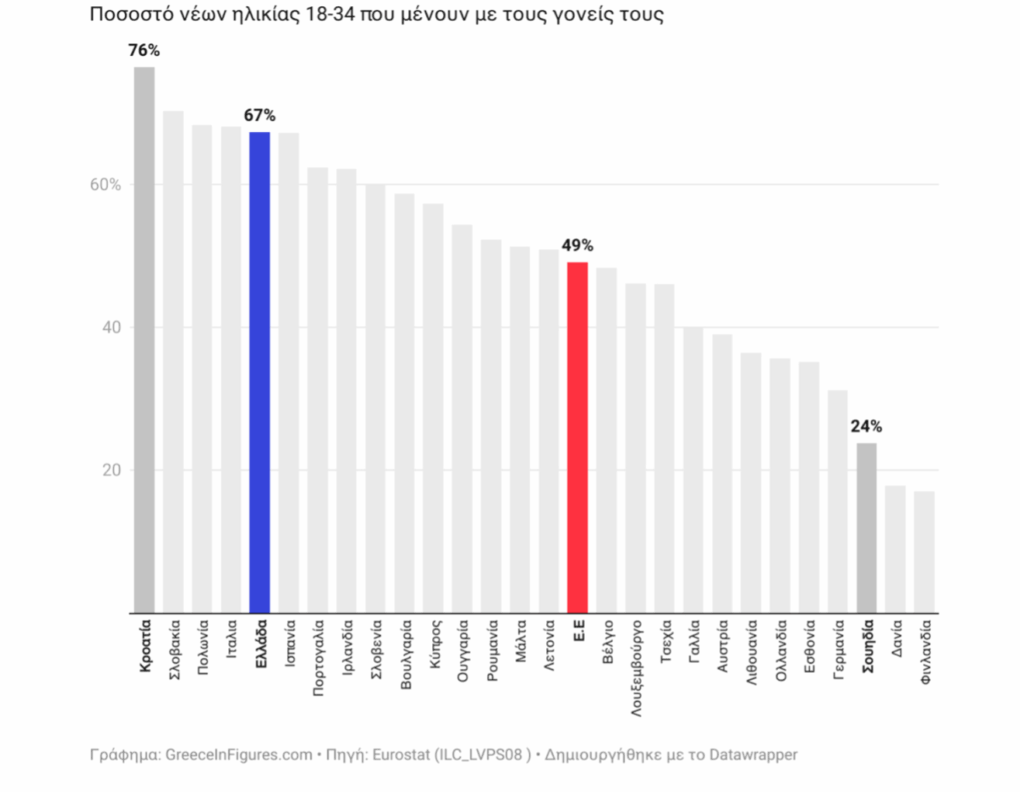
Such a trend is alarming, as it risks becoming a mechanism for reproducing social inequalities—where opportunities are determined not by individual effort but by family background—thus deepening institutional and social divides.
Rising costs as an additional source of pressure
The housing crisis interacts with a broader economic environment that is increasingly unfavorable for young people. In this context, the rising cost of living plays a crucial role, further intensifying existing inequalities.
Inflation is shaping a new socio-economic reality: higher expenses for basic goods, reduced purchasing power, and job instability. According to data from the Bank of Greece, prices increased by 13.9% in 2023 and 8.7% in 2024, while household disposable income rose by only 8.1% and 5.6% respectively.
This gap demonstrates that price increases consistently outpace income growth, undermining young people’s social mobility and trapping them in conditions of constant pressure and economic dependence.
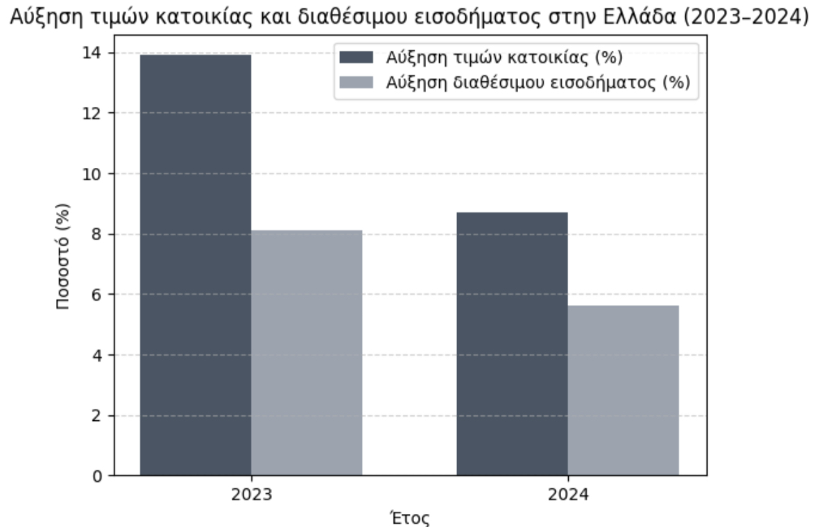
Inflation does not only affect short-term consumption but also long-term life planning.
Job insecurity at the core of the youth experience
Amid these challenges, young people are also trapped in another mechanism that hinders their progress: precarious employment. Entry into the labor market often occurs through temporary contracts, part-time work, underpaid internships, and informal employment arrangements, which rarely provide stable income or sufficient social protection.
Career paths are characterized by geographic mobility, alternating periods of employment and unemployment, transitions between formal and informal work, and hybrid forms of employment (multiple jobs, parallel employment, or work alongside studies).
At the EU level, “flexible employment” is often promoted as a strategy to combat unemployment. In practice, however, this flexibility frequently translates into low-paid and unstable jobs. Examples such as zero-hour contracts in the Netherlands, the expansion of the gig economy in the UK, and low-pay flexible job models associated with Germany demonstrate that flexibility without sufficient institutional protection leads to prolonged insecurity.
Although youth unemployment in the EU decreased from 24.4% in 2013 to around 15% by the end of 2024, this improvement mainly reflects quantitative integration into the labor market rather than the quality of available jobs.
Greece remains at the lower end of relevant indicators: 48% of young people report financial support from parents or relatives as their main source of income, while 41% are willing to move abroad to find work. This increasing willingness to migrate—beyond contributing to the “brain drain” phenomenon—reveals not just a survival strategy, but a deeper sense of frustration due to the lack of prospects for professional advancement domestically.
Seeking solutions through institutional and social action

European Union initiatives for affordable housing are diverse, with potentially significant contributions despite their complementary nature. The “European Affordable Housing Plan” reflects a gradual repositioning of housing at the center of European social policy.
According to Eurocities’ Housing Monitor, affordable and social housing has become a key priority for local governments, which are experimenting with various interventions—especially in areas where tourism displaces vulnerable residents who lack alternative housing options. A characteristic example is the transformation of small, low-cost semi-basement and ground-floor apartments in central Athens into short-term rental units.
At a broader level of social policy, the EU has also placed strong emphasis on supporting youth employment. The Youth Guarantee, established in 2013 and strengthened in 2020, has helped around 50 million young people by offering opportunities for employment, education, or training within a short period.
Complementary programs such as ALMA (Active Labour Market Integration for Young People) and Erasmus+ enhance skills and social mobility through scholarships, internships abroad, youth exchanges, and volunteering programs. Erasmus+, in particular, acts as an institutional counterbalance to inequalities in access to quality education, aiming not to benefit only the already privileged but to redistribute opportunities and strengthen a more cohesive and inclusive European social fabric.
At the same time, young people themselves are emerging as active agents, demanding a meaningful role in addressing social challenges. At both national and European levels, they are developing new forms of political participation and collective action, advocating for a more just, sustainable, and inclusive society. Their engagement extends beyond traditional institutions into a diverse ecosystem of activism and community initiatives.
Conclusion
Housing insecurity, rising living costs, and precarious employment are not isolated or temporary phenomena, but interconnected aspects of a broader social condition that challenges the cohesion of modern societies.
For the younger generation, these issues are not merely economic difficulties; they shape their ability to achieve autonomy, social integration, and meaningful participation in society. Under these conditions, it is essential not only to recognize the difficult realities they face, but also to understand that their criticism of a society that fails to provide stability and prospects is not a sign of disengagement, but an expression of deep frustration and a demand for justice.
References
- Maloutas, T. & Siatitsa, D. (2025) The housing issue in the European Union and Greece: Key components and policy responses, ELIAMEP, 30/09/2025.
- Nikolaidis, I. (2023) Housing policy in Greece and Europe, diaNEOsis, April 2023.
- Georgakopoulos, T. (2017) Youth unemployment and intergenerational relations in Greece, diaNEOsis, July 2017.
- Karageorgou, A.K. & Gousis, K. (2024) Precarious work as the “new normality”: A discussion with G. Tsiolis on his new book, Eteron – Institute for Research and Social Change.
- European Commission (n.d.) Youth employment support, Directorate-General for Employment, Social Affairs and Inclusion.
- Eurostat (2024) Young people living with their parents – EU statistics.
- Bank of Greece (2025) Economic developments and inflation in Greece, Athens: Bank of Greece.
- Eurofound (2023) Young people and the cost-of-living crisis, Luxembourg: Publications Office of the European Union.













5 Comments
Dawn4312
https://shorturl.fm/qVEP0
Blair304
https://shorturl.fm/8rTTo
Wade480
https://shorturl.fm/ejINW
Carmen4361
https://shorturl.fm/EsnFO
Evie265
https://shorturl.fm/VrcdL