From Maria-Evangelia Arevythi
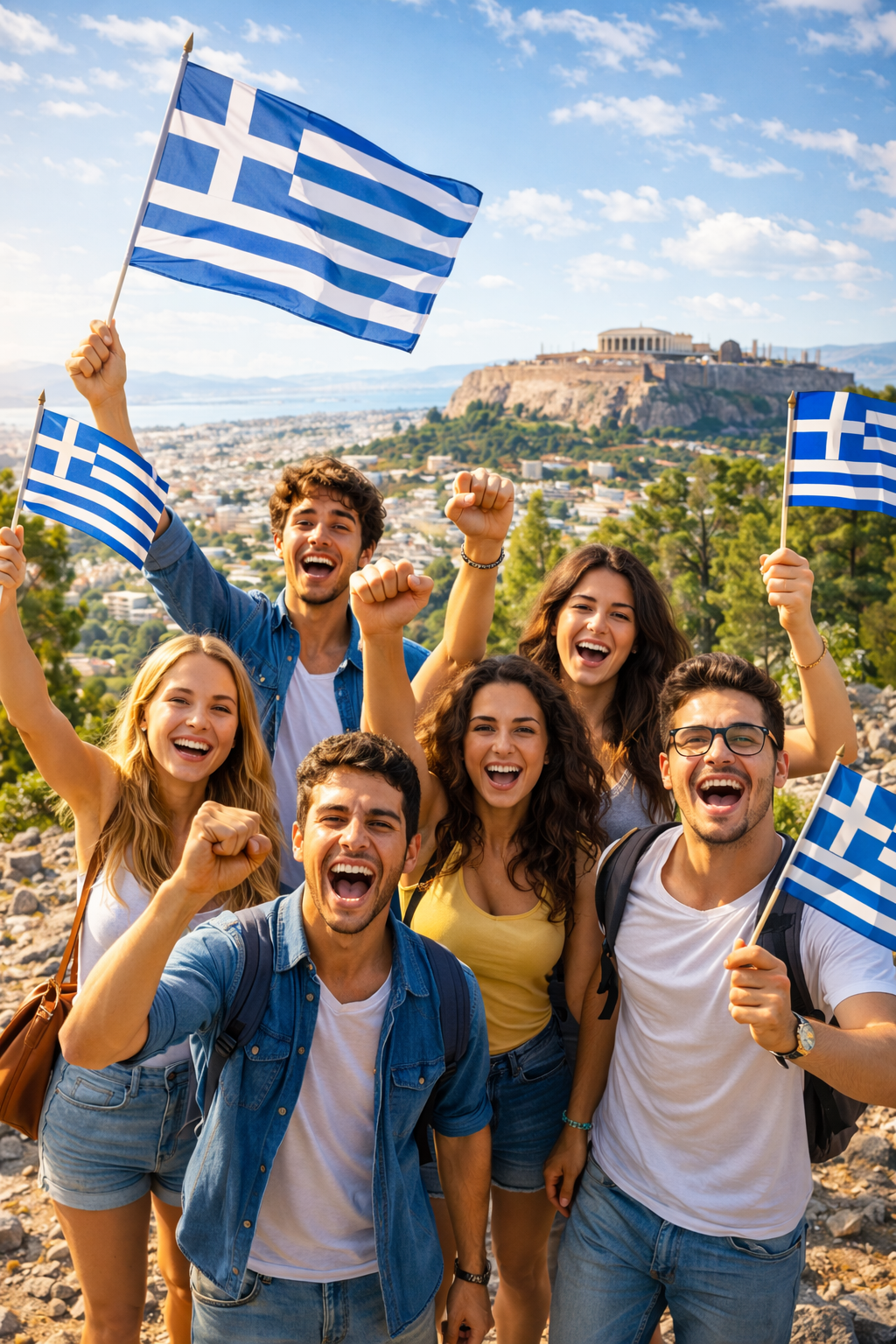
The fact that democracy in Greece today is undergoing a period of reflection and renewal is now widely accepted. The relationship between young people and politics does indeed seem contradictory. On the one hand, abstention rates in elections are steadily increasing, while on the other, young people choose to participate actively in social movements, solidarity initiatives, Non-Governmental Organizations (NGOs), and even online campaigns. One could say that this transition reveals not a distancing from democracy, but an entirely new way of understanding its highest principle. This article will explore how young people in Greece are tending to redefine political participation by choosing forms of action that correspond to the values, needs, and tools of contemporary digital politics.
Abstention as a Sign of Distancing, Not Indifference
Young people’s abstention from elections has been the subject of intense discussion within social and political discourse. As confirmed by the Institute of Democracy (2023), more than 45% of voters under the age of 30 did not participate in the most recent national elections. Although we usually interpret this as indifference, abstention often expresses distrust toward parties and institutions, which are seen as inadequate in representing the needs of the younger generation. Therefore, young people do not reject politics as a concept in itself, but rather its older forms.
Distancing, therefore, does not necessarily mean withdrawal from public life. Instead, the turn toward new alternative forms of participation reveals a more critical, contemporary, and, for some, mature relationship with democracy.
From the Party to the Community: New Forms of Participation
The concept of the political is changing and being significantly redefined by Greek youth. Public dialogue is shifting from political parties to communities, social networks, and NGOs. Movements such as Fridays for Future, MeToo, and Black Lives Matter, as well as Greek initiatives such as “Without Middlemen” and “Solidarity for All,” demonstrate young people’s preference for horizontal, participatory structures over hierarchical ones, such as those found within political parties.
Digitalization and the growing presence of digital platforms in everyday life also play a decisive role in accepting this new democratic reality. Through X, Instagram, or TikTok, young people express opinions, mobilize communities, and shape real public debates. “Digital activist culture” provides the necessary space for political expression beyond traditional institutions, forming new symbols of collectivity, such as hashtags, which now hold a central position and tend to create a new way of producing terminology, leading toward new ideological approaches and reflections. (Jenkins, 2020)
Citizenship in Practice: Social Action as a Political Stance
According to the European Commission’s 2022 report (European Commission, 2022), youth participation in voluntary and non-governmental organizations in Greece increased by the striking figure of 35% in just the last five years. This shift not only reveals the practical dimension that citizenship is acquiring today, but also demonstrates in practice that the political aspirations of the younger generation are not limited to voting; rather, they are expressed through action and a sense of collective responsibility.
In their effort to find the meaning and impact they are seeking, young people connect participation with a new approach to democracy, one that functions “from the bottom up.” This is achieved, for example, through organized examples such as environmental campaigns, social grocery stores, or actions for human rights. (Inglehart and Welzel, 2005)
The New Generation Has Values; It Is Not Indifferent
Younger generations are strongly characterized by sensitivity toward issues of equality, sustainability, and transparency. As the OECD (2023) also states, despite their disappointment with political parties, this generation maintains high levels of interest in democracy as a value. Social justice, environmental protection, and technological ethics constitute the central pillars and assumptions of their political thought. Young people in Greece are therefore increasingly participating in transnational networks, connecting local activism with global demands. In this way, a new kind of political identity is being formed: globalized, networked, and value-oriented, going beyond the national boundaries of traditional democracy.
Conclusion
In conclusion, democracy in Greece is not shrinking; it is transforming. Young people are not turning against politics or rejecting it. They are simply moving it to where they subjectively find its meaning: in the streets, on social networks, and in the communities to which they belong or to which they would like to belong one day. Active citizenship now has a contemporary version, one charged with collective action, digital systems, and lived experience.
The challenge, therefore, for the political system and its institutions is to recognize the new reality and dynamic that is emerging and to develop institutional bodies that communicate directly and meaningfully with the values and needs of young people. A democracy in transition, one that does not fear change but is willing to embrace it, can once again become highly attractive—not only as an institution, but as an experience and a way of life.
Bibliography
- Dalton, R. (2017). «The Participation Gap: Social Status and Political Inequality». Oxford University Press.
- European Commission. (2022). «Youth in Europe: Civic and Political Participation Report». Brussels: European Commission.
- Gerbaudo, P. (2021). «The Digital Party: Political Organisation and Online Democracy». Pluto Press.
- Inglehart, R. & Welzel, C. (2005). «Modernization, Cultural Change, and Democracy». Cambridge University Press.
- Institute of Democracy. (2023). «Youth and Electoral Participation in Greece». Athens: Institute of Democracy.
- Jenkins, H. (2020). «Participatory Culture in a Networked Era». Polity Press.
- OECD. (2023). «Civic Engagement and Youth Attitudes Towards Democracy». Paris: OECD Publishing.