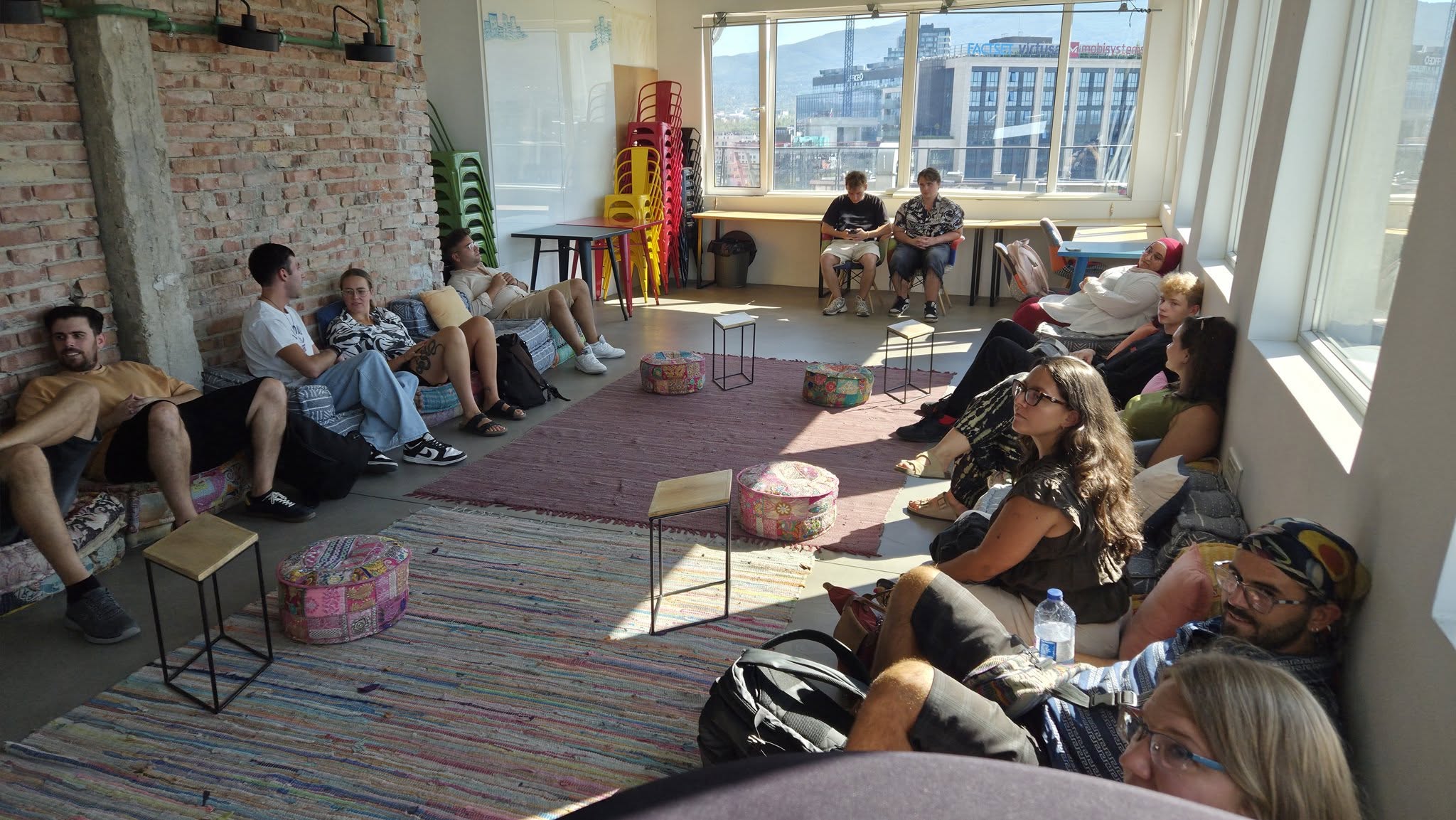
From 8 to 10 September 2026, young participants gathered in Sofia for a three-day international training activity designed to demonstrate how financial education can go beyond traditional classroom learning. Through gamification, experiential activities, and collaborative problem-solving, the programme encouraged participants to develop practical financial skills while exploring the city in an innovative and engaging way.
The training programme included icebreaker activities, interactive quizzes, the Financial Reality Café, financial simulation exercises, and group reflection sessions. However, one of the highlights of the event was the Sofia GAMEY Urban Challenge, an exciting city-wide learning experience that transformed everyday situations into opportunities for financial education.
Equipped with their GAMEY Passports, participants explored Sofia while completing seven interactive challenges, each designed to strengthen their understanding of financial concepts and develop essential life skills.
Through the Trade Like a Roman activity, participants travelled back in time to explore the evolution of trade, comparing ancient commercial practices with modern entrepreneurship. In another challenge, they stepped into the role of bankers, developing their own rules for saving, borrowing, managing expenses, and ensuring online financial security.
The experience also encouraged participants to reconsider the meaning of value. By exploring public spaces and everyday experiences, they discovered that some of life’s most valuable opportunities, including well-being, recreation, and community engagement, can come at no financial cost.
Entrepreneurship was another central element of the Urban Challenge. Participants identified real opportunities within the city and developed small start-up concepts, considering potential customers, pricing strategies, initial investment requirements, and business risks.
During the Temptation Street challenge, teams became financial detectives, comparing real market prices, distinguishing between needs and wants, and examining how advertising influences consumer behaviour and purchasing decisions.
The activities combined practical learning with creativity, teamwork, photography, videos, and additional bonus missions, making financial education both accessible and enjoyable.
Another important activity was the Future Kit Challenge, during which participants were asked to plan their future using a hypothetical budget of €1,000. Working in teams, they evaluated different priorities, including financial independence, technology, professional development, personal experiences, emergency savings, and investment in future entrepreneurial ideas.
On the final day, participants transformed the knowledge and experiences gained throughout the programme into innovative business or social enterprise concepts. Each team developed and presented an idea aimed at responding to real challenges or opportunities identified in Sofia, combining financial awareness with creativity and social innovation.
For Action for the Civil Society, participation in initiatives such as GAMEY reflects our commitment to empowering young people through non-formal education, innovative learning methodologies, and practical skill development.
The Sofia training activity demonstrated that financial literacy is not simply about understanding numbers, budgets, or financial transactions. It is about developing confidence, critical thinking, creativity, collaboration, and the ability to make informed decisions in everyday life.
Through experiential learning and international cooperation, the GAMEY Project continues to create meaningful educational opportunities that equip young people with the knowledge and skills needed to navigate an increasingly complex financial world.